
Baseball
The Smallest Market Won the Pennant. Baseball May Shut Down Anyway.
Oct 28, 2026 · By Alex Charles
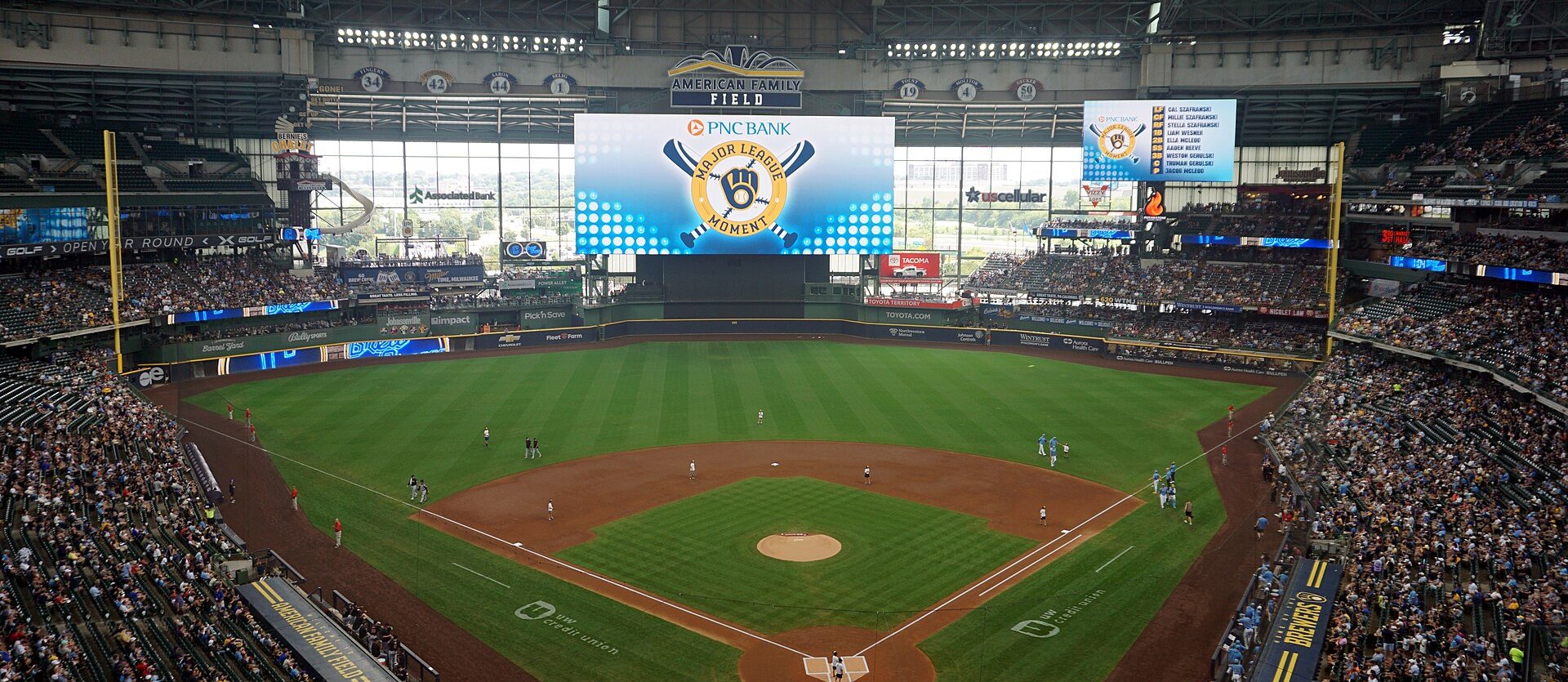
On Friday afternoon, Oct. 23, a few hours before the first World Series pitch thrown in Milwaukee since 1982, the commissioner of baseball stood on the field at American Family Field and explained why the evening about to happen was evidence of a system that does not work. "The Brewers have been a well-run franchise forever," Rob Manfred said. "It's been 40 years since we're here. Once every 40 years is not enough."
The people filing in behind him had begun lining up six hours before the parking lots opened, by Front Office Sports' count, and more than ten before first pitch. Milwaukee is the smallest market in the major leagues, 38th in the country, and the Brewers opened the season with the 19th-highest payroll in baseball, $124.1 million by the Associated Press's figures. The team they were about to play, the Tampa Bay Rays, opened at $88.7 million, 26th by the AP's count and 27th by Sports Business Journal's. The Mets, who finished 74-88, began the year at $352.2 million. It is the first World Series between two bottom-half payrolls since Minnesota and Atlanta in 1991, and ESPN notes that the winner will be the first small-market champion since the 2015 Royals.
Thirty-nine days after Manfred spoke, at 11:59 p.m. Eastern on Tuesday, Dec. 1, the collective bargaining agreement between the 30 clubs and the players' union expires. Both sides told Sports Business Journal in Milwaukee that an extension to avoid a lockout was unlikely. The owners want a salary cap, which they had not formally proposed since 1994, and the union has said for three decades that it will never accept one. The World Series in front of them is the exhibit, and each side is holding it up as proof. What follows is what each has actually put on paper, what happens one minute after midnight on Dec. 2, and why the two cities whose teams are playing are the argument in miniature.
What the owners put on the table
Bargaining opened on May 12. The union went first, on May 27, with a package it described as improving pay at every level and rewarding competition. The owners answered the next day, Thursday, May 28, with the proposal that has defined everything since: a seven-year agreement running from 2027 through 2033, built around a hard salary cap of $245.3 million and a salary floor of $171.2 million, measured the way the luxury tax measures payroll, which means roughly $20 million of benefits and bonus-pool money counts against every club's number.
The league published its own illustration using 2026 Opening Day payrolls. Eight clubs would have had to cut a combined $578 million to get under the cap: the Dodgers, Mets, Yankees, Blue Jays, Phillies, Red Sox, Padres and Braves. Twelve would have had to add a combined $617 million to reach the floor. The twelve include the Marlins, Guardians, White Sox, Cardinals, Nationals, Pirates, Twins, Athletics, Rockies and Reds, and two others: the Tampa Bay Rays and the Milwaukee Brewers. Under the owners' own plan, both teams in this World Series would have been required to spend more than they did to get here.
The rest of the proposal is the part the league talks about least and the union worries about most. Players would receive 50 percent of defined baseball revenue, the split the other three major leagues use, with an independent accountant to verify the books. Every club's local media revenue would be pooled and shared equally among the 30, which the league says would end local blackouts and make the current revenue-sharing system unnecessary. MLB's case for all of it is a pair of numbers: league revenue up 247 percent since 2003, player payroll up 149 percent. "Under our proposal, major league players will receive more compensation in year one of the system than in 2026," league spokesman Glen Caplin said in June. "We are ready to listen if the MLBPA wants to counter our proposal at the bargaining table."
The owners have been unusually willing to say so in public. Hal Steinbrenner, whose Yankees carried a $336 million payroll for tax purposes this year, sits on the labor policy committee. "I helped craft, one of many, the proposals that we have given at the bargaining table," he said at the Yankees' end-of-season press conference on Oct. 21. "And I support those proposals in their entirety." Two years earlier he had said, "I don't believe I should have a $300 million payroll to win a championship." On the eve of Game 1, Mark Attanasio, who has owned the Brewers since 2005, was asked about Steinbrenner's position. "Ditto for me," he said.
What the players answered
The union's statement on May 28 ran to three paragraphs and did not use the word negotiate until the last sentence.
For generations, our members have fought against cap systems because they harm players at all levels, erode or eliminate contractual guarantees, pit player against player, lead to more work stoppages, not less, and get worse for players over time. Caps don't lower ticket prices for fans, eliminate tanking or ensure teams are run with equal competence. They suffocate competition by offering owners an all-purpose excuse for inaction and mediocrity.
"Billionaire owners are not seeking to cap their profits or asset values, only player salaries," the statement went on. The union's own May 27 package, as reported by Sports Business Journal, would guarantee every smaller-market club at least $240 million in annual revenue through expanded sharing, on the condition that the club carry a payroll of at least $150 million; raise the minimum salary to $1.5 million in 2027; eliminate the qualifying offer; let players with five years of service reach free agency at 30; and lift the luxury-tax threshold from $244 million to $300 million. Bruce Meyer, the union's interim executive director, said in June that the owners' cap would have cost players more than $500 million in 2026 alone.
Meyer has run the union since Feb. 18, the day after Tony Clark resigned following an internal inquiry and amid a reported federal investigation into union finances. Meyer was already the chief negotiator in 2020 and 2022 and kept the job. Standing on the same field as Manfred before Game 1, he gave the players' reading of the matchup.
The salary cap is the opposite of competition. The salary cap tells teams you can't compete too much. ... The results of these playoffs obviously further undermine their argument for why they think they want it. But again, that's not the reason why they want it.
He called the owners' demand "the nuclear bomb of the salary cap," said the league's stated reasons were "a charade," and said the owners were "going to make a choice presumably to lock the players out." He also conceded the point the league leans on. "If every team concluded tomorrow that we don't have to spend any money on players and we can still win, of course that would not be a good thing," Meyer said. "And it would also not be a good thing for those teams because I don't think you could win that way in the long term."
Manfred's reply, the same afternoon, was that the cap is not the only thing on the table. "Everybody's focused on the fact you have a salary cap on the table, and Bruce doesn't like that," he said. "Well, he has a whole lot of proposals on the table that we don't like. We're going to have to get through that." He described the owners' unanimity on the cap as without precedent in his time and cited the league's own polling of fans. "No one ever said that differences in economics are perfectly outcome determinant," he told ESPN. "If you look at the data, our larger markets have a very statistically significant advantage in terms of making the playoffs and going deeper into playoffs."
What happens one minute after midnight
The league has already written the manual. On Oct. 1, Deputy Commissioner Dan Halem sent owners and senior club executives a confidential 34-page memo on how to operate during a lockout, which The Athletic's Evan Drellich obtained and reported on Oct. 7. "Our commitment has been and remains to exhaust every realistic option to achieve our goal of reaching an agreement with the Players Association," Halem wrote. "However, clubs need to be prepared for the possibility that an agreement will not be reached by then and the clubs are left with no realistic alternative but to implement a lockout of major league players."
What follows is specific. Every piece of business between a club and any player on its 40-man roster stops: no trades, no signings, no conversations about either. MLB's digital arm will build alternate versions of every club and league website with the players' likenesses removed, and "player names and pictures would be removed from article headlines," as happened for 99 days in the winter of 2021. Team stores can keep selling jerseys, because those rights come through the union's licensing arm rather than the labor agreement. Players who left cars at team facilities for the winter must collect them. Club officials are told to avoid players "to the greatest extent possible," because "the line between permissible and prohibited conversations is not always clear"; staff invited to a player's wedding may go, but may not talk business. Players are free to play in Japan or in the winter leagues. Clubs are told to document every late-season medical interaction, in case a player later claims an injury that predates the stoppage. And one line has travelled further than the rest: "Sending Players holiday cards or gifts would not be permissible during a Lockout. Clubs could send holiday cards or gifts to players prior to Dec. 2."
The calendar after that is fixed, and short. Spring training games are scheduled to begin on Friday, Feb. 19, with all 30 clubs playing. Opening Night is Wednesday, March 24, a single game streamed on Netflix, followed on Thursday, March 25, by a 14-game Opening Day, the earliest in the sport's history; the Associated Press's headline on the schedule release ended with a conditional, if there is a season. In 2022 the sides needed a deal by about March 10 to play 162 games, and this year's earlier start moves that line forward. There is one incentive on the owners' side that did not exist last time. CBS Sports, citing The Athletic, reported that if a stoppage runs deep enough into the season to cost 60 or more games, most of the league's national broadcast and streaming contracts would extend by a year, to 2029, which would delay the centralized media deal the league hopes to sell in 2028. A lockout that ends in February costs the owners little. One that reaches June costs them the thing they are locking out to get.
The last two times
Baseball has been here twice in the working lives of the people negotiating, and the two precedents point in opposite directions.
The recent one is the 2021 lockout. It began at 12:01 a.m. on Dec. 2, 2021, froze about 250 free agents in place and took the players' faces off MLB.com for three months. On March 1, 2022, the league cancelled the first two series of the season; on March 10 the union voted 26-12 to accept a deal and the owners ratified it 30-0 that night. Opening Day moved from March 31 to April 7 and all 162 games were played, with 31 doubleheaders and three extra days in October. The stoppage lasted 99 days and cost nothing that could not be rescheduled. "I do want to start by apologizing to our fans," Manfred said that day. "I know that the last few months have been difficult."
The older one is the reason the union counts in generations. In June 1994 the owners proposed a salary cap and the end of salary arbitration. The players struck after the games of Aug. 11. On Sept. 14, with no agreement in sight, the acting commissioner cancelled the rest of the season and the World Series, the first time since 1904 that it was not played. "We ran out of ground," he said at a news conference. "It's tragic, but I wasn't going to allow the most important games of the season to become a farce." The acting commissioner was Bud Selig, and the news conference was held at Milwaukee County Stadium, because Selig owned the Brewers. They were 53-62 when the season stopped. The strike ran 232 days and ended on April 2, 1995, two days after a federal judge in Manhattan named Sonia Sotomayor issued an injunction against the owners. It cost more than 900 games, about $580 million in club revenue and $230 million in salaries, and when baseball came back for a 144-game season, average attendance fell from 31,256 a game to 25,008, a drop of 20 percent.
The owners got their cap in neither case. The sport has had a luxury tax, on and off, since 1997 instead, and the tax, not a cap, is the system the Brewers and Rays reached the World Series under.
Milwaukee's case, and Tampa's
Attanasio bought the Brewers in 2005. "I said the two things I didn't want to hear was, 'We're too small' or 'We can't do this,'" he told reporters on Oct. 22. "I actually kept trying to say we were a mid-market team even though clearly we weren't." His team won 103 games this year, a franchise record and the first 100-win season in its history, swept the Dodgers in the National League Championship Series, and did it with a 24-year-old ace, Jacob Misiorowski, who went 16-5 with a 1.80 ERA and 252 strikeouts, and a third-year manager, Pat Murphy, who won Manager of the Year in each of his first two seasons. Then its owner endorsed a plan built on the premise that teams like his cannot keep doing this. "This has been our goal for 22 years, to compete," Attanasio said. The proposed revenue-sharing system, he said, "not only will help us compete" but would help every club with a lower payroll, "which is something also I think the fans want."
The building he said it in has been paid for twice by the public. Miller Park, as it opened in 2001, was financed with $290 million from a 0.1 percent sales tax across Milwaukee County and four of its neighbors, a tax that ran from 1996 to 2020 and collected about $605 million for construction and upkeep before it expired; the state senator whose vote passed it, George Petak of Racine, was recalled for it. In December 2023 Gov. Tony Evers signed a second package: $365.8 million from the state in annual payments through 2050, $135 million from the city and county, a surcharge on tickets to concerts and other non-baseball events, and $110 million from the club, in exchange for a lease that keeps the Brewers in Milwaukee until 2050. "The fan support, the sponsorship support, the support from our leaders in the community in the state has allowed us to punch above our weight," Attanasio said, "and the payroll and whatnot reflects that."
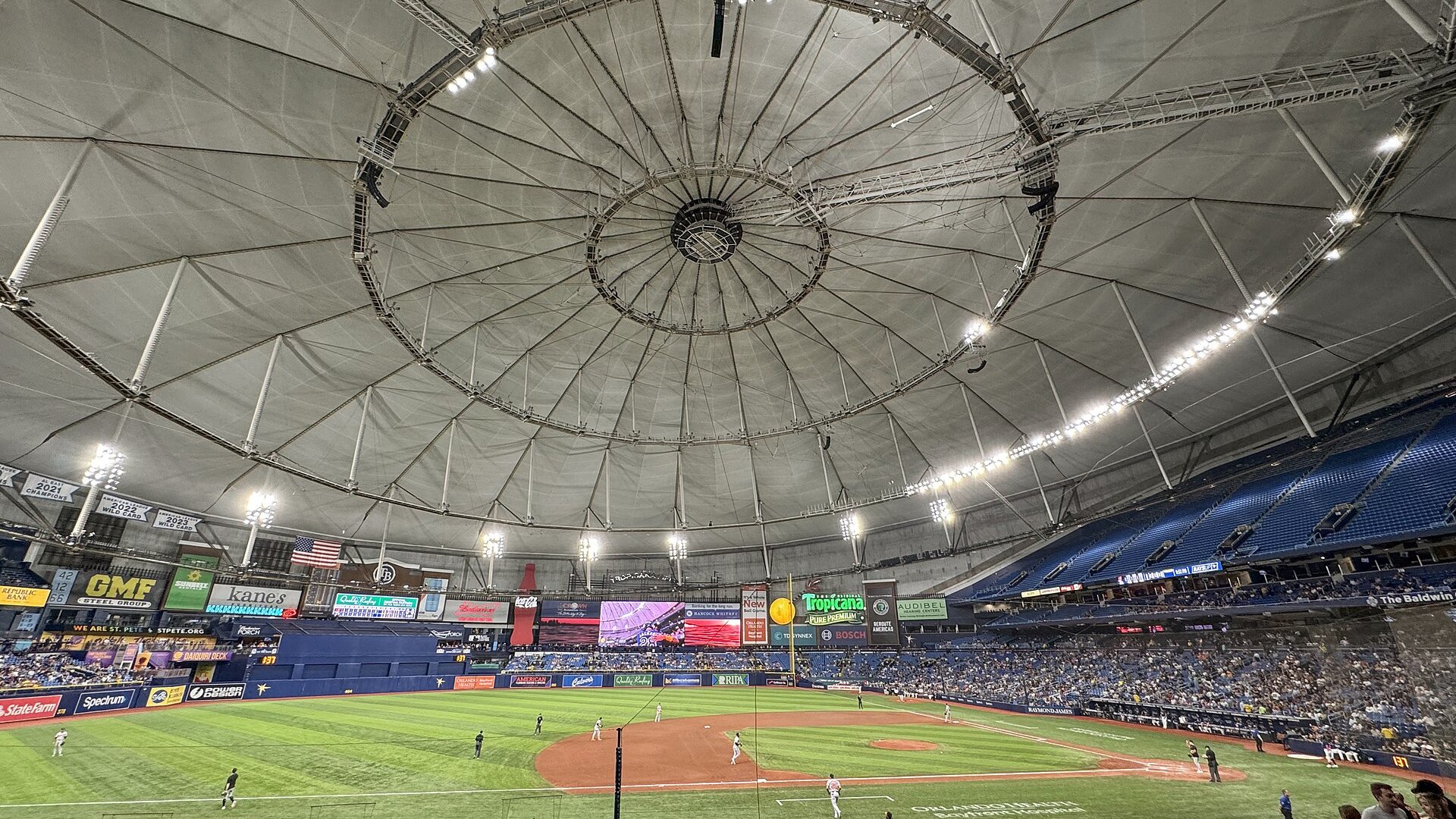
Tampa's version is the same story under a different roof. The Rays won 98 games, the most in the American League, with one of the five smallest payrolls in the sport, in a dome that lost its roof to Hurricane Milton in October 2024 and reopened this April after about $58 million in repairs. They will leave it after 2028 for a $2.3 billion ballpark in Tampa of which Hillsborough County, the city and federal disaster funds are to cover roughly $1 billion. Under the owners' plan the Rays would have to raise payroll to reach the floor. Under the union's plan they would be guaranteed $240 million in revenue on condition that they spend at least $150 million of it on players. Both proposals would make Tampa Bay spend more. They disagree about who pays for it, which is the whole fight.
What a ticket is worth on Dec. 2
We should say where we sit. Ticket Wallet is a resale marketplace. A season that starts late is a season with fewer games to list, and a cancelled game is a refund to process rather than a sale to make. We are not neutral about whether there is baseball in March.
The demand this autumn is not in question. In our snapshots of listings across the major resale marketplaces, at noon on Friday, seven hours before Game 1, the cheapest seat at American Family Field was $2,041 and the median listing was $4,926; the cheapest seat for Game 3 at Tropicana Field, three days later, was $707. Front Office Sports reported that the final get-in price for Game 1, $2,338 by TicketData's count, was the highest for any World Series game on record. Attanasio said last week that he was "getting a lot of questions about ticket prices," and his explanation was that the city suspects it might be another 44 years.
What a lockout does to that is mostly a matter of dates. In 2022 the only games lost were in spring training, and MLB's fan guide offered a refund or a credit for them; the regular-season games cancelled in March were put back on the schedule and the tickets were honored on the new dates. Clubs are selling 2027 season tickets now, and their terms for unplayed games vary: the Orioles' current postseason terms, for one, refund payments toward games not played or apply them to the next year's balance. Most marketplaces carry a ticket to a postponed game's new date and refund one that is cancelled outright. The time to read the terms, wherever you bought, including here, is before Dec. 1.
The weeks in between
The Rays won Game 4 on Tuesday night, 4-3 in 12 innings, on a bouncing single to right by Ben Williamson after Cooper Pratt's home run in the top of the inning had put Milwaukee three outs from its first championship; the Series goes to a fifth game at Tropicana Field on Wednesday with the Brewers ahead three games to one. The sides met as recently as last Thursday and say they will keep meeting. "I'm not prepared to write the process off as ending in a really ugly labor battle," Manfred said in Milwaukee. Halem's memo has a line for the weeks in between. Clubs may send their players holiday cards, it says, provided they do so before Dec. 2. The Brewers have until the first of December to mail theirs.
Sources: ESPN (Jesse Rogers, Oct. 24, 2026); Sports Business Journal (Mike Mazzeo, Oct. 24; Oct. 20; Oct. 8; June 1); the Associated Press (Ronald Blum, Oct. 23 and May 28; Opening Day payrolls, April 9; the 2027 schedule, July 16); Front Office Sports (Oct. 22 to 24); USA Today (Gabe Lacques, Oct. 22); SNY and CBS Sports on the Yankees' Oct. 21 press conference; MLB.com, including the league's "Level the Playing Field" summary of its proposal, the 2027 schedule release and its March 10, 2022 report on the last agreement; the MLBPA's statements of Feb. 17, Feb. 18 and May 28, 2026; The Athletic's Oct. 7 reporting on the Oct. 1 memo as carried by Sports Business Journal, RealGM and the New York Post; CBS Sports' lockout guide; the Los Angeles Times, Sept. 15, 1994; the Bureau of Labor Statistics' Monthly Labor Review, March 1997; the Wisconsin Legislature's October 2023 hearing materials on Assembly Bill 438; the Associated Press on the December 2023 stadium package; MLB.com, the Rays and Bay News 9 on the Tropicana Field roof; the USA Today Network on the Rays' Tampa ballpark; Baseball-Reference. MLB.com (Anthony Castrovince and Sarah Langs) and USA Today on Game 4, Oct. 27 and 28. Market data: Ticket Wallet 30-minute snapshots of secondary-market listings across major marketplaces for the 2026 World Series, Oct. 23, 2026. Photos: Michael Barera (CC BY-SA 4.0) and Quintin Soloviev (CC BY 4.0), via Wikimedia Commons.