
Soccer
The $3 Billion Matchday: What the World Cup Did to Ticket Prices, and to the Cities That Hosted It
Sep 27, 2026 · By Jake Sanchez
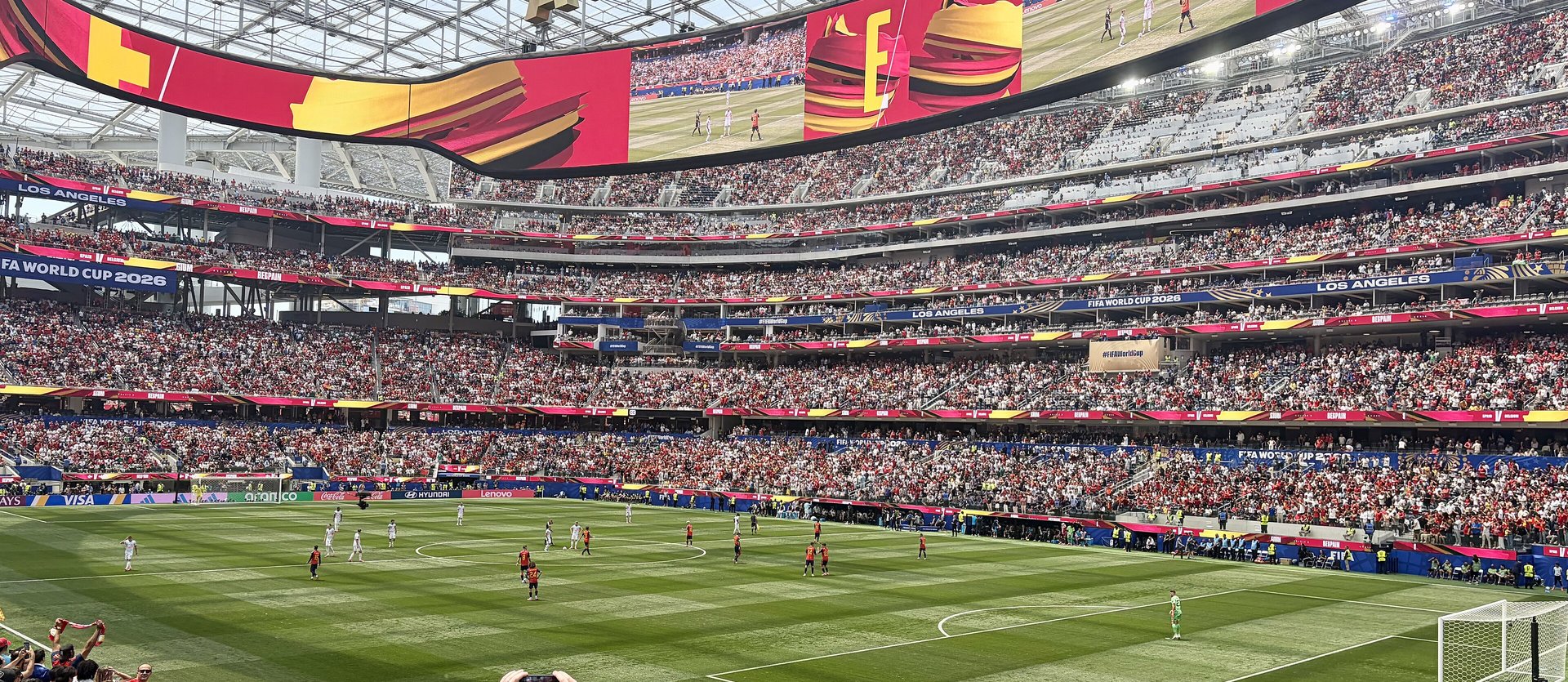
By halftime of the final on July 19, Bill Lohr already had his number. Lohr runs the food, drink and merchandise at MetLife Stadium for Delaware North, and he told Sports Business Journal he expected the building to finish the day with about $3 million in concessions and another $3 million in retail. With the premium clubs counted, he figured the total would land near $11 million, the stadium's single-event record from Super Bowl XLVIII in 2014. There were 80,663 people in the seats. About 16,000 of them had come in on hospitality packages, including a dozen on-the-pitch packages that cost $1 million apiece for all eight matches at the stadium. In our snapshots that morning, the cheapest resale seat in the building was $6,023.
That was one match out of 104, and FIFA counted 6,810,966 people at them, an average of 65,490 a game and 99.7 percent of the seats, more than the 2018 and 2022 tournaments put together. The day before the final, Gianni Infantino told FIFA's member associations that revenue for the 2023 to 2026 cycle would "top the USD 15 billion mark." FIFA had budgeted $13 billion in April and $11 billion before that. The Guardian reported that tickets and hospitality, including FIFA's cut of its own resale market, explained a large share of the jump.
This is a piece about where that money came from and where it went. We watched the tournament from the resale side, where our pricing models snapshot every listing across eight-plus marketplaces every 30 minutes, and we'll bring that in where it says something the official numbers don't. Ticket Wallet is a resale marketplace, so we aren't a neutral observer here.
What one match took in
FIFA hasn't published a final ticketing figure, and its Council meeting on October 15 came and went without one. What it did say is that the cycle will close with an unaudited surplus of $5.2 billion to $5.6 billion. So the answer has to be a range. FIFA's budget put ticketing and hospitality for this World Cup at about $3 billion, against $929 million in Qatar. Divide that by 104 matches and you get about $29 million a match, or $440 for every person who walked through a turnstile. Qatar's equivalent was $14.5 million a match and $273 a head.
The budget was almost certainly low. The Athletic documented that FIFA's April prices were more than double the Qatar equivalent in every category for every match, and Qatar's average ticket came to $216. If every 2026 seat had sold at twice that, tickets alone would come to about $2.9 billion, which is roughly FIFA's whole matchday budget before a single hospitality package. On Location, which ran hospitality, reported more than $2 billion in gross sales through June on about 568,000 packages, an average of around $3,500 each. GlobalData, citing reports, now puts ticketing and hospitality above $5 billion. At that level a match is worth about $48 million and a seat about $735.
Then there's the money that never touched FIFA's primary ledger. Lohr's $11 million at MetLife is one stadium's cut of one afternoon. FIFA took 15 percent from the buyer and 15 percent from the seller on every resale through its own platform. The resale network we track cleared 141,199 tickets for 85 matches in the United States and Canada, about $90.8 million at an average of $643, and $11.2 million of that was the final alone. The whole secondary market was larger than what we see. Put it together and a routine group match in an American stadium was a $30 million to $50 million day. The final was several times that: 16,000 hospitality seats at On Location's average is $56 million before anyone counts the other 64,000 tickets, which FIFA listed at anywhere from $2,030 when sales opened to $10,990 by April.
Smaller than Sunday
Those 6.8 million people fit into buildings that were, on paper, smaller than usual. The day before kickoff FIFA confirmed its tournament capacities. MetLife Stadium, which sells 82,500 seats for a Giants game, was listed at 80,663. AT&T Stadium in Arlington, 80,000 for the Cowboys and past 100,000 with standing room, was 70,649. Arrowhead went from 76,416 to 69,045. Toronto's BMO Field was the smallest venue at 43,036, even after a $99.8 million renovation that added about 17,000 temporary seats.
The seats went to the game itself. A FIFA pitch is wider than an NFL field, so the front rows come out. Washington's stadium authority paid $3.3 million to widen the field at Lumen Field and another $1.85 million to cover every non-sponsor brand name in the building. Camera platforms and the hospitality builds take more. An attendance of 6,810,966 at 99.7 percent implies about 6.83 million seats, so roughly 20,000 went unfilled across the entire tournament, fewer than half of one night at BMO Field. Sports Business Journal counted the final as the 70th sellout of the 104 matches.
How the prices got there
FIFA had never used demand-based pricing at a World Cup before. It opened in October 2025 with a Category 1 ticket to the final at $6,730, already about four times the Qatar equivalent, and kept moving. The Athletic, working from screenshots fans sent in, found that "Between October and April, FIFA hiked prices in at least one ticket category for 95 of the World Cup's 104 matches; the average increase was 35 percent." By April the top final ticket was $10,990. In the sales phase after the December draw, the cheapest public seat was $140, in Category 3 for the least attractive group games. Football Supporters Europe says the original bid had promised tickets from $21.
The pushback came in layers over the winter and spring. In December FIFA created a $60 "Supporter Entry Tier," limited to a tenth of each federation's 8 percent allocation. That works out to about 1.6 percent of the seats, a little over 1,000 a match, and the federations handed them out rather than selling them to the public. In March, 69 members of Congress wrote to Infantino. In May, New York's mayor, Zohran Mamdani, negotiated 1,000 nontransferable $50 tickets for city residents across seven matches, not including the final. "To put that into perspective, that is five lattes in New York City," he said in Harlem. Peter Moore, the former Liverpool chief executive, told Al Jazeera that "Dynamic pricing doesn't belong in the World Cup and football," and called the whole arrangement "dystopian."
Infantino's answer, delivered at the Milken Institute conference in Beverly Hills on May 5, was that FIFA was pricing to the market it was in.
We have 25% of the group stage tickets which can be bought for less than $300. You cannot go to watch in the U.S. a college game, not even speaking about a top professional game of a certain level, for less than $300. And this is the World Cup.
The same day he was asked about four lower-deck seats for the final listed at nearly $2.3 million each on FIFA's own resale platform. A listing isn't a sale, he said, and if anyone did pay $2 million he would "personally bring a hot dog and a Coke to make sure that he has a great experience." FIFA says it received more than 500 million ticket requests in a 33-day window. In February Infantino said every match was already sold out, and FIFA later corrected that to say it expected every match to sell out.
What the open market said back
The clearest test of the pricing came at the one game FIFA struggled to sell. On April 10, an internal planning document seen by The Athletic listed 40,934 tickets purchased for the United States against Paraguay at SoFi Stadium on June 12. Iran against New Zealand, in the same building three days later, was at 50,661. FIFA held its Category 1 price at $2,735 anyway. Two weeks out there were more than 3,500 unsold seats on the primary portal and 6,500 more on FIFA's resale platform. Three hours before kickoff, in our snapshots, the cheapest ticket into the building was $950 and the median listing was $2,044. The building filled anyway, and by the final whistle 8,417 tickets for that one game had gone through the resale network we track, at an average of $1,172. That is about $9.9 million in secondary sales for a group match on the tournament's second day.
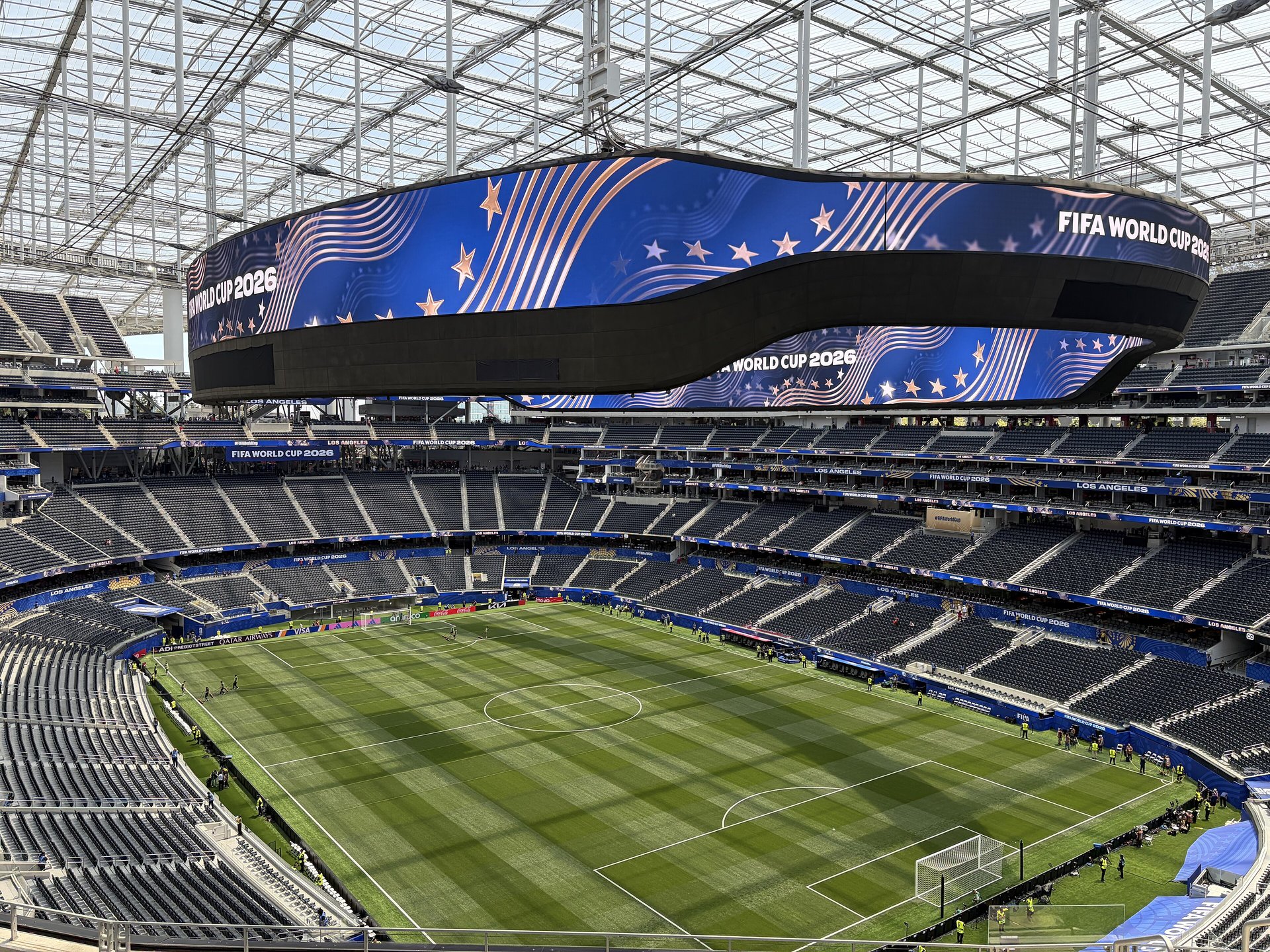
The cheap end of the tournament looked nothing like the headlines. Across the 62 group matches we tracked, 29 had a match-day get-in under $575 and five were under $300. Spain against Cabo Verde in Atlanta had a $170 floor, and Cabo Verde against Saudi Arabia in Houston moved 8,572 tickets on our network at an average of $208, the most of any match in the tournament. At the other end, 22 group matches had a tenth-percentile price above $1,000 on match day, and Colombia against Portugal at Hard Rock Stadium was $2,968 to get in.
The knockout rounds were where the money moved. For most of the time those tickets are on sale nobody knows who is playing, so sellers price the matchup they're hoping for. A week before the round of 32 the median asking price across those games was $2,601, and on match day it was $979. The round of 16 fell 64 percent from a week out to match day, and the quarterfinals fell 66 percent. Spain against Belgium at SoFi on July 10 had a median of $6,110 and 823 listings seven days before. On the morning of the match the median was $1,698. That isn't scalpers losing their shirts so much as a market repricing from a hypothetical to a fact, and it took about 72 hours every time.
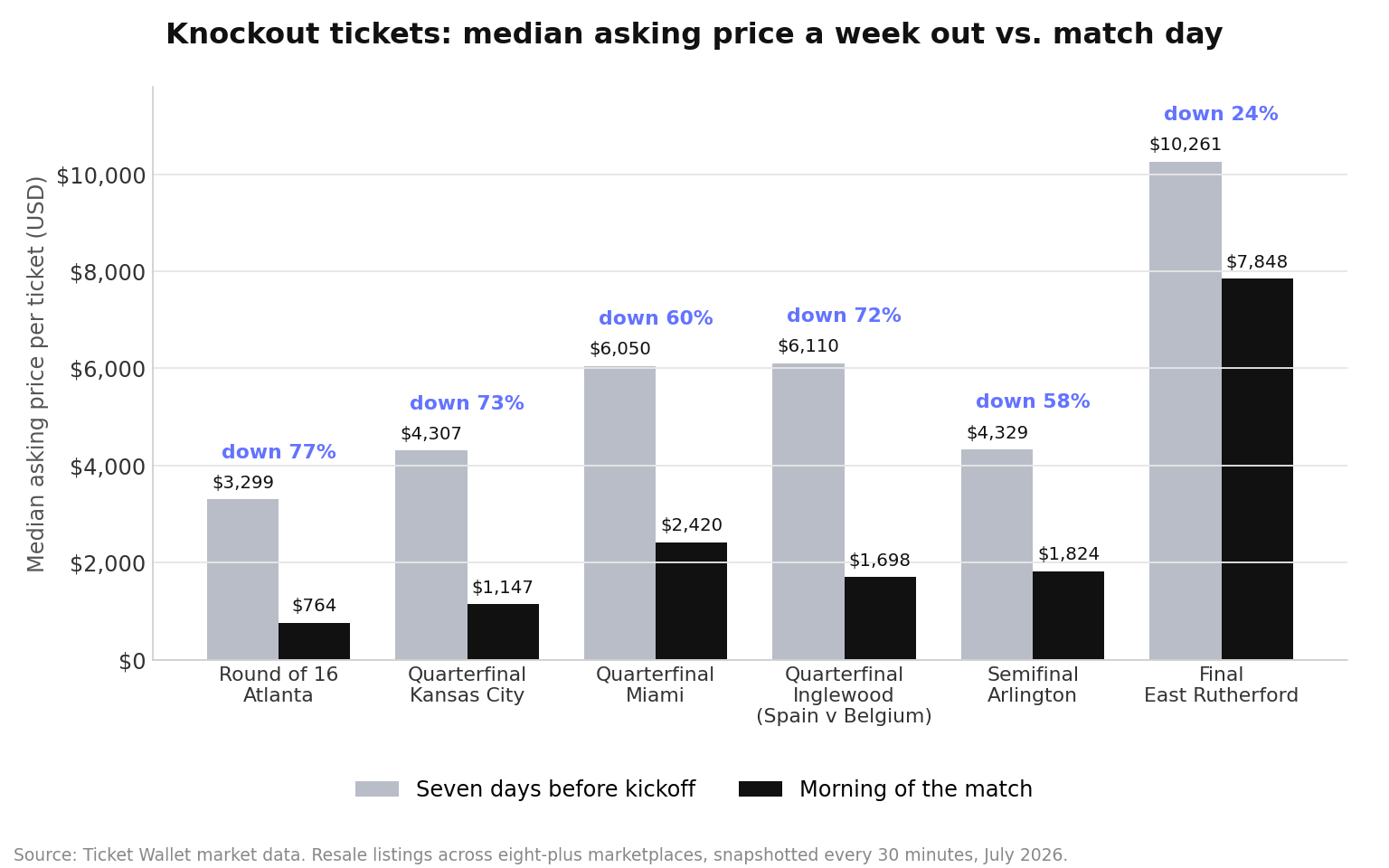
The final was the one match where the pattern broke. The median listing was $16,500 in January, $11,000 on June 1 and $7,848 on the morning of July 19. The floor barely moved in that time, from $6,600 on June 1 to $6,023 on match day. On our network, 1,290 final tickets sold at an average of $8,664. Sixty-eight percent of them sold in the last 48 hours at an average of $8,059, while the 69 people who bought a month or more out paid $11,392. The fans who committed early paid about 40 percent more than the fans who waited, and they sat in the same building.
The cities' ledger
Every host committee has now published its number, and the numbers are large. Tourism Economics, working for the New York New Jersey Host Committee, put the region's total impact at $3.5 billion, above the $3.3 billion it had projected. Behind that was $1.9 billion of direct spending from 645,000 match attendees and 626,300 more visitors who came for fan events. Visit Seattle reported $889 million and $109 million in state and local tax. Mexico's tourism ministry counted 7.8 million "travelers" across its three host cities and 65 billion pesos, about $3.6 billion, in economic activity.
Read the footnotes and the picture changes. Of Mexico's 7.8 million travelers, 4.5 million were day-trippers. Deloitte counted 494,000 tourists against the 836,000 it had forecast, and Reuters' headline two days before the final was that the economic goal "never came." Seattle's own report says hotel occupancy fell against the same weeks in 2025 because the tournament displaced cruise passengers and convention traffic, and KUOW tallied about $120 million in public money spent to get ready. New York's City Council has since put on the record that the city spent about $90 million preparing and collected about $51 million in related tax. In Toronto, hotel occupancy for the week ending June 20 was 72 percent, down from 88 percent a year earlier, and Canadian governments spent about C$1.1 billion to host 13 matches.
The hotel data is the most useful ledger there is, because nobody commissioned it. CoStar found that group bookings at luxury and upper-upscale hotels in host markets fell 20.5 percent in the last week of the group stage, while the same class of hotel elsewhere was up 9 percent. HVS, working from CoStar's numbers, estimated the tournament produced $680 million in extra room revenue across the 11 U.S. markets, and New York took about half of it. Occupancy finished below its baseline in seven of the 11 cities, worst in Seattle at 6.3 points down. Tourism Economics' own national estimate came in at $634 million, which it compared to 6.5 Super Bowls. Before the tournament it had talked about nearly $900 million and 10. Overseas arrivals to the United States were 7 percent lower in July than a year earlier.
What did show up was food and drink. Bank of America's card data had spending in host cities up about 5 percent over the tournament, driven by out-of-towners spending 17 percent more, with Kansas City the leader at 7 percent. The bank saw no lift in hotel spending at all, which it put down to rooms booked and paid for long before. FIFA, for its part, counted 675,000 hot dogs and 5.5 million beers.
The cost side is the part the studies tend to skip. FEMA put $625 million into security for the 11 American host cities and another $221 million into counter-drone systems. Kansas City, the smallest U.S. host, spent about $248 million in public money by one local tally, including roughly $50 million of work at Arrowhead and a $25.8 million modular jail that wasn't ready in time. Three states waived at least $57.8 million in ticket taxes, The Athletic found. The $1 million "legacy contribution" that FIFA executives verbally promised each U.S. host city hadn't been paid as of August, according to The Athletic. Boston's mayor, Michelle Wu, said she "was not aware of any plans for that." New York's City Council introduced a resolution in September asking for the check.
None of this surprised the people who study it. In 2004, Robert Baade and Victor Matheson went back over the 1994 World Cup, which organizers had said would add $4 billion to the American economy. They found that host cities had lost somewhere between $5.5 billion and $9.3 billion against trend. Their paper asked whether the award of a World Cup is "an honour or a burden." Matheson told The Globe and Mail this summer that the hotel numbers were "exactly what economists expected: that there would be basically displacement." Wolfgang Maennig of the University of Hamburg told KUOW that when academics go back over a mega-event afterward, "if academic studies find some effects, they are very, very, very small and very, very short term."
What it means for the next one
Los Angeles hosts the Olympics in two summers, and the ticketing model FIFA ran this year is already the template: sales windows, inventory held back, prices that move with demand and an official resale market that takes a cut. On Location says it has booked $280 million in LA28 hospitality at an average order of $14,500, two years out. For fans, the lessons from this tournament are practical. Don't buy a knockout ticket before you know who is in it. Watch the last 48 hours, when most of the volume moves. And compare across matches rather than within one: on June 27 the cheapest seat for Colombia against Portugal in Miami was $2,968 and the cheapest for Algeria against Austria in Kansas City was $383, the same afternoon. No single event page shows you both, which is why we rebuilt our search around an AI assistant during the tournament. You can ask it for the cheapest way into any match that week and see every price all-in, with no buyer fees.
FIFA has not said when, or whether, it will publish what the tournament took at the gate. The $1 million it told the host cities to expect had not arrived as of this month. The hot dog, as far as anyone has reported, was never delivered.
Sources: FIFA's "World Cup 2026 by the numbers" pages and its Oct. 15 Council release; FIFA's 2022 annual report; The Guardian, July 18; The Athletic's World Cup reporting by Henry Bushnell and Adam Crafton, including the ticket saga explainer and the host-city payments story; Sports Business Journal, July 19; TKO Group and On Location sales disclosures; GlobalData; AP and Reuters; Al Jazeera, April 27; BBC Sport, May 7; the NYC Mayor's Office; Tourism Economics for the NYNJ Host Committee and its national hotel analysis; Visit Seattle and KUOW; Mexico's Secretaria de Turismo via Excelsior; Deloitte via El Economista; Reuters, July 17; The Globe and Mail; CoStar; HVS; Bank of America Institute; FEMA; KSHB; New York City Council Res. 0655-2026; NY1; Baade and Matheson, Regional Studies (2004). Market data: Ticket Wallet 30-minute snapshots of secondary-market listings across eight-plus marketplaces for the 91 World Cup matches played in the United States and Canada, plus de-duplicated sales from the resale network's sales feed for 85 of those matches; the 13 matches in Mexico are not in our feed. Photos: Alexis Doine (CC0, hero and SoFi Stadium) and Kaisersauce1 (CC BY 4.0, Levi's Stadium), via Wikimedia Commons.