
Sports
The $6 Seat: How the Giants Ticket Market Fell Off a Cliff
Sep 27, 2026 · By Jake Sanchez
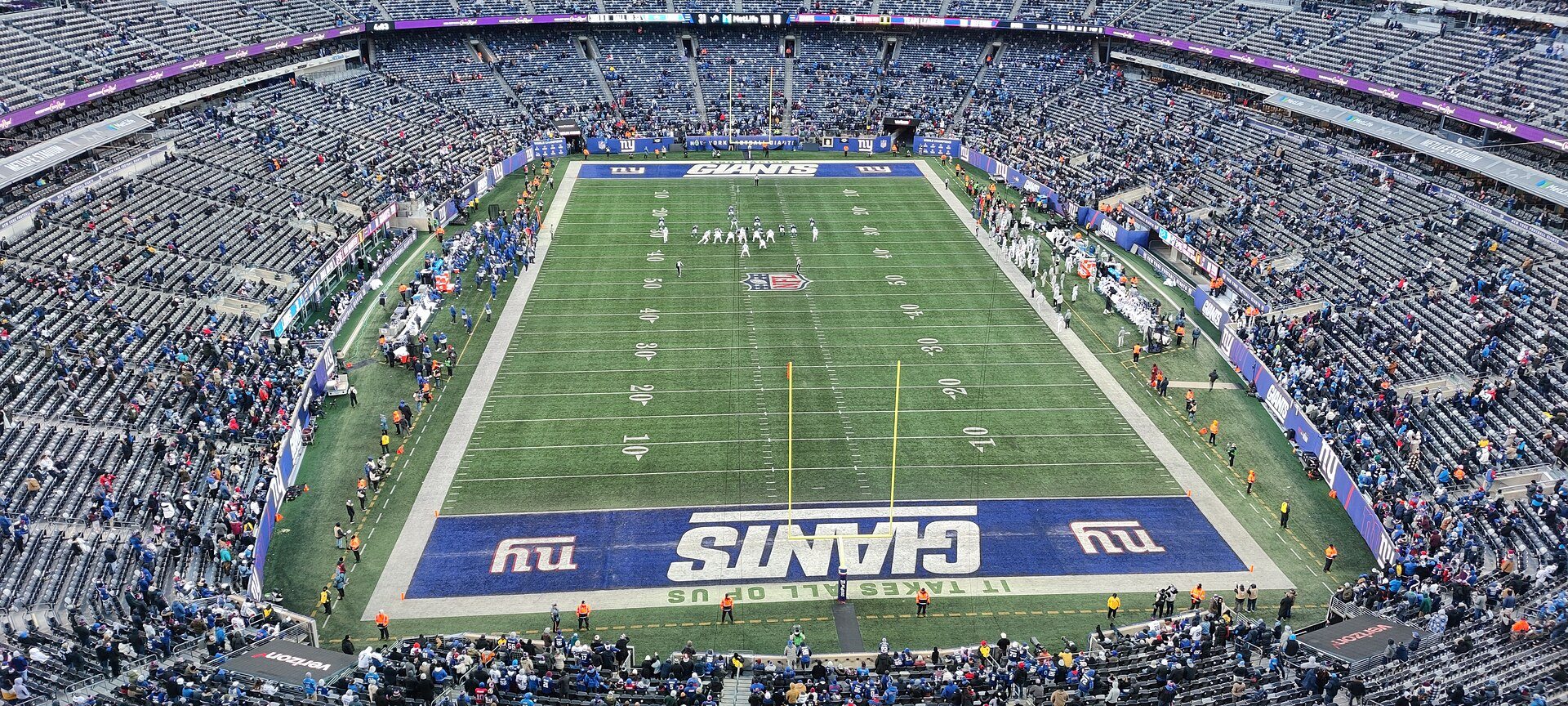
At 12:32 on Sunday afternoon, 28 minutes before the Giants kicked off against the Titans, the cheapest pair of tickets on the resale market was in Section 328, Row 25, for $6.36 apiece. That is less than a beer inside the building. Behind them sat two dozen more upper-deck listings under $10. Six days earlier, the typical ticket to this game listed for $247 and the cheapest tenth of the market went for $155. By kickoff the median listing was $19.
On Thursday we wrote about what Jaxson Dart's knee did to Giants prices in the first 72 hours. That turned out to be the first act. The second was a nor'easter. The third was game morning, when what was left of the market went over the edge. Here is the whole week, from our own 30-minute snapshots of the resale market.
Three hits in six days
The first hit was the injury. Dart went down on the opening drive Monday night in Los Angeles, and by Tuesday the market was marking down every Giants home game. Wednesday brought the second: season-ending surgery, John Harbaugh saying his quarterback was out for the “regular season at least,” and Jameis Winston named the starter. By Thursday afternoon the get-in price for the Titans game had gone from $77 to $21.
Then the weather turned. By Friday evening New Jersey had declared a state of emergency in eight coastal counties, and the National Weather Service had East Rutherford at a 90 percent chance of rain on Sunday, with a northeast wind of 21 to 25 miles per hour and gusts as high as 47. A wind advisory ran until noon and a coastal flood warning until 6 p.m. The sportsbooks pulled the point total from 45.5 to under 38. The opponent didn't help: the Titans came in 0-2 with a second-year quarterback averaging 161 passing yards a game. Robert Saleh and Brian Daboll coming back to the Meadowlands is a fine story for the press box. It does not sell a wet seat in the 300 level.
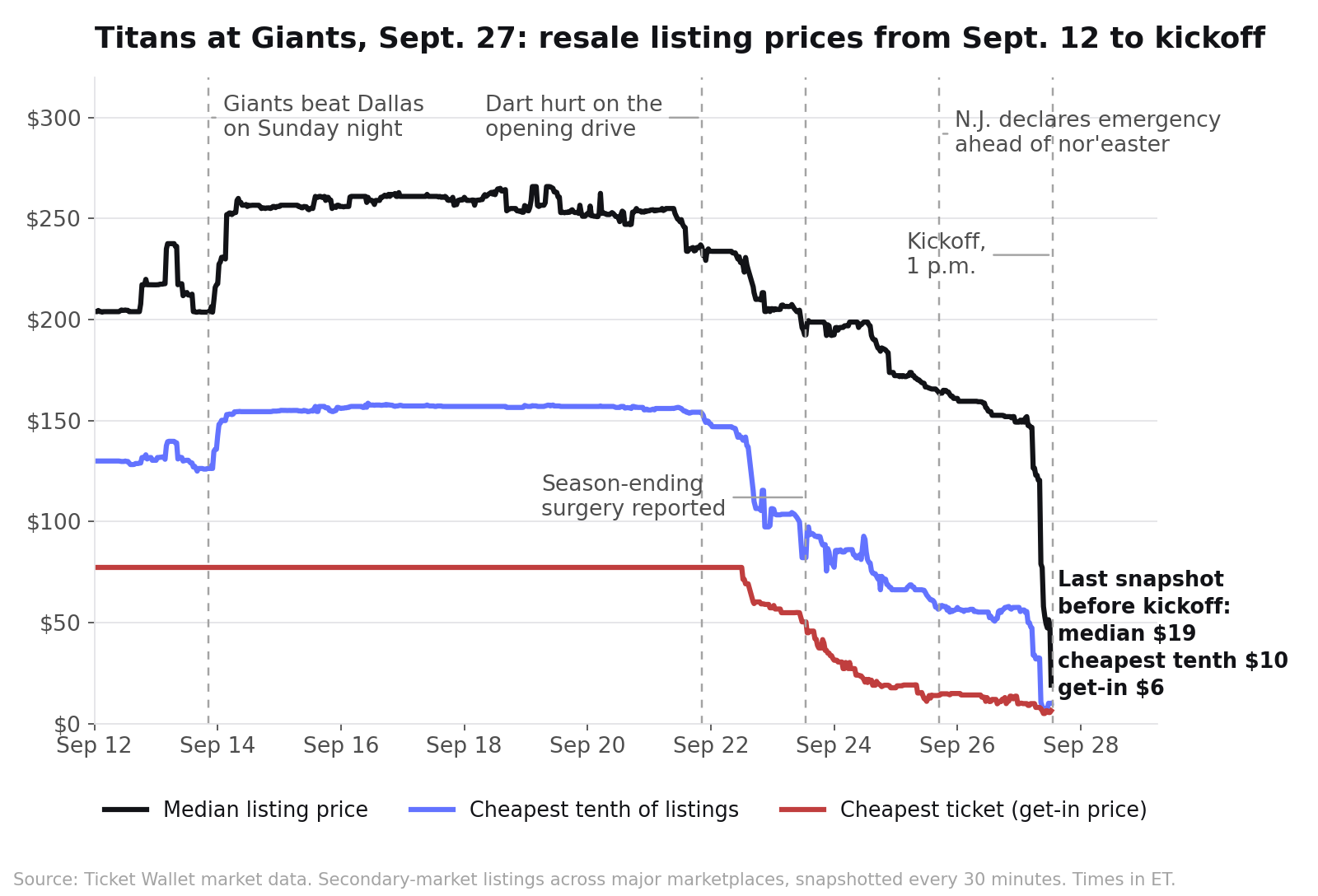
Friday at noon the cheapest ticket was $11 and the median was $167. Saturday at noon: $12 and $155, with 9,848 tickets for sale, more than at any point all season. Sunday at 6 a.m., with the rain coming down: $10 and $126. Then the sellers woke up. The cheapest ticket in the building was cut to $6.36 at 8:34 a.m. Eight of the ten cheapest listings at kickoff were repriced at 8:39, almost certainly one seller pulling the plug on a block of upper-deck pairs. By 8:30 the median was $79. By 10 it was $53. By 12:30 it was $19, with 321 tickets left on the market and nobody left to buy them.
From Monday afternoon to kickoff, the median listing fell 92 percent, the cheapest tenth of the market fell 93 percent, and the get-in price fell 92 percent. Between 6 a.m. and kickoff alone, the median fell 85 percent.
This is not how game week usually goes
NFL tickets always drift lower during game week. A ticket is a perishable good, and a seller with an unsold seat on Sunday morning has until 1 p.m. to become a seller with nothing. Economist Andrew Sweeting documented the pattern in baseball: resale prices fall 40 percent or more as a game approaches, and sellers who reprice as they go come out about 16 percent ahead of those who don't. Football works the same way. Across the 41 other NFL games this season that had kicked off by Sunday at 1 p.m., the median listing fell 39 percent from six days out to kickoff, from $385 to $220. It was down about 18 percent by the day before the game and fell another 24 percent on game day itself.
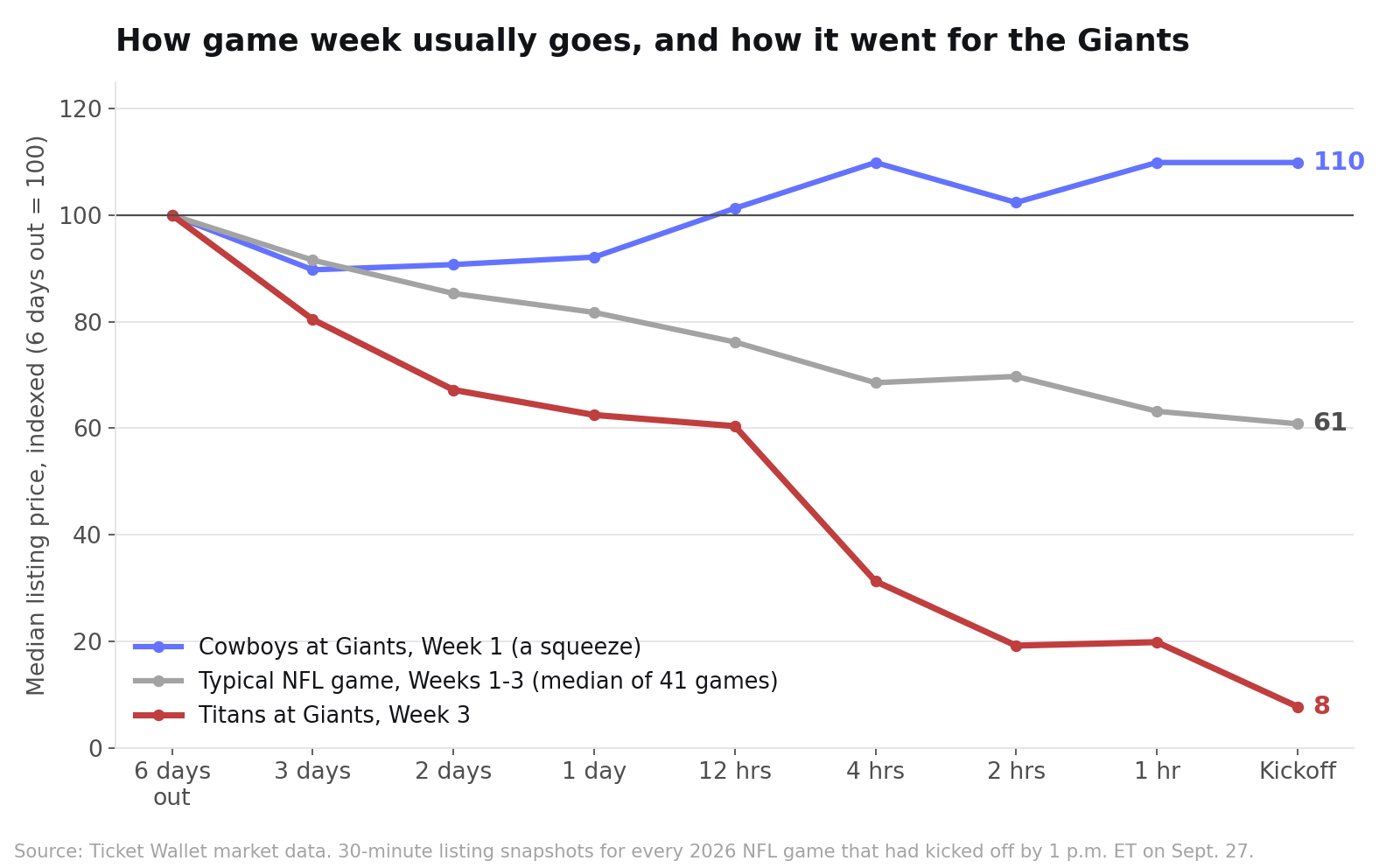
What normally holds is the floor. The typical get-in price barely moves over game week, and in 16 of those 41 games the cheapest ticket cost more at kickoff than it did the day before, because bargain hunters clear out the cheap seats first. The median comes down; the bottom of the market gets bought. That is the shape of a normal NFL Sunday.
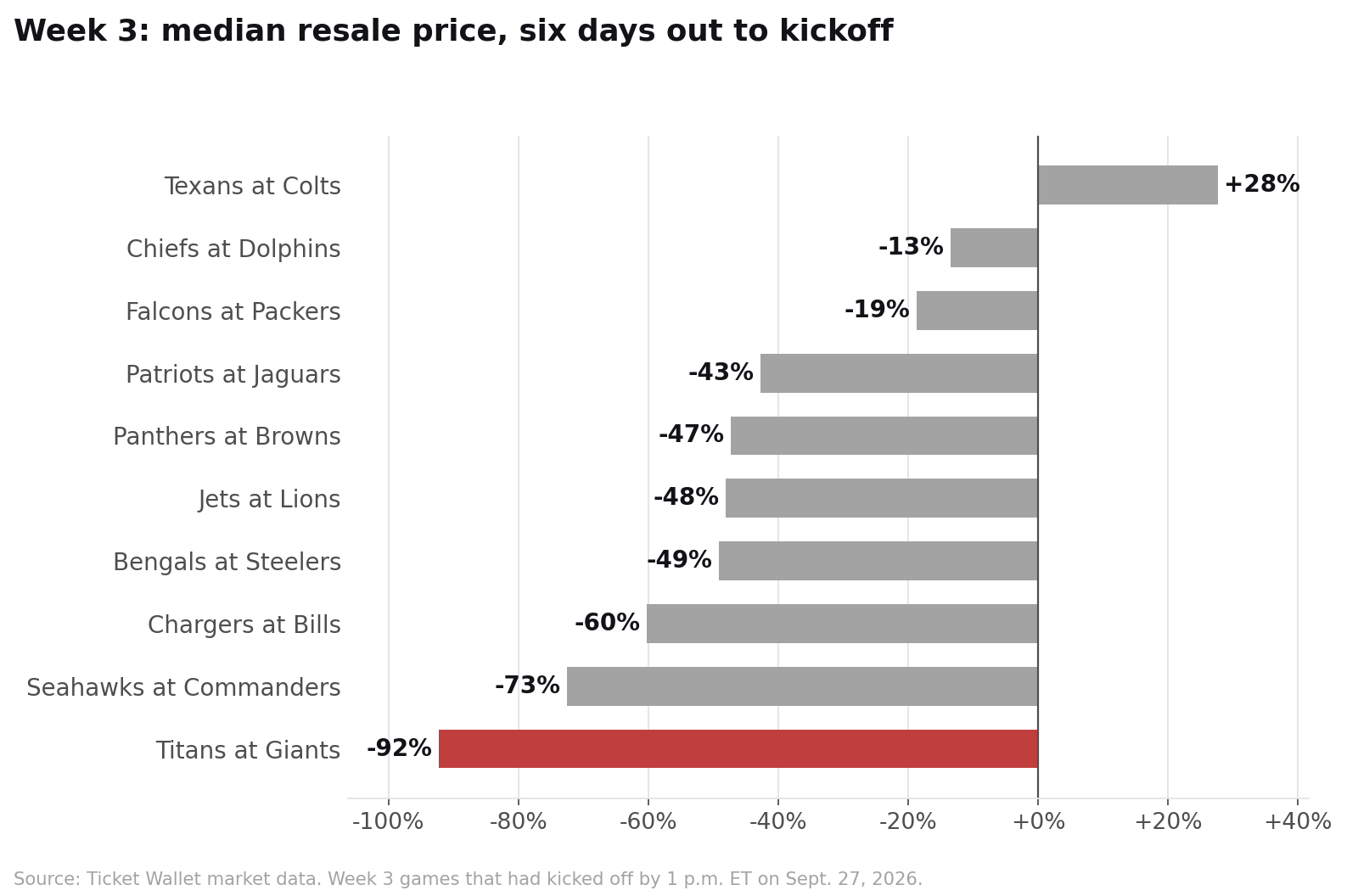
The Giants game broke the shape. It was already down 38 percent by Saturday, double the usual drift, and then it fell another 88 percent in the final 24 hours, against a normal final-day drop of 24 percent. Among the other nine Week 3 games that had kicked off by 1 p.m., the typical decline for the week was 47 percent and the worst, Seahawks at Commanders, was 73. At kickoff the typical game on this year's schedule had a $220 median and an $87 get-in. The Giants had $19 and $6.36. It was the cheapest ticket to any NFL game this season. The next cheapest get-in at kickoff, Cardinals at Chargers in Week 1, was $18.
Why the floor gave way
Prices fall when demand falls. They collapse when the last buyer leaves. On a normal Sunday morning there is a fan in Hoboken who will take a $30 upper-deck seat on a whim. This Sunday that fan looked at the radar: rain at 90 percent, gusts near 50, a backup quarterback, an 0-2 opponent and a flood warning for the drive home. The whim went away, and the sellers who had waited all week for it hit the button at the same time. When the marginal buyer disappears, the floor is not a floor anymore.
Weather does this on its own. In January 2024, the get-in price for the Steelers-Bills wild card game was $200 the day the matchup was set and under $75 by Friday, once the forecast called for two feet of lake-effect snow; the game was pushed to Monday. The same weekend, the Dolphins-Chiefs game played at four below zero had a $50 get-in on Friday. Bad opponents do it too: Jets at Titans in Week 1 had a $29 floor at kickoff. A backup quarterback does it. Stack all three on one afternoon and you get Section 328 for the price of a sandwich.
The other direction: the squeeze
It cuts both ways, and the best example is the same building. Ten weeks before Sunday, MetLife Stadium hosted the World Cup final. The get-in price climbed past $10,000 in the final days and settled above $7,000 in the hours before kickoff. SeatGeek's average purchase price was $12,751, the most expensive sporting event in American history, more than $2,000 above the record set by the 2024 Super Bowl. Nobody who held a Category 3 seat into the final week regretted it.
The Knicks have run the same play two springs in a row. Game 1 of the 2025 Eastern Conference finals opened with a $580 get-in and a $1,193 average purchase price on TickPick, a record for a conference finals game. By the time a Game 7 was on the table, the get-in was $1,099. This June, the get-in for Game 3 of the Knicks' NBA Finals was roughly $7,000. That is a squeeze: fixed supply, demand that keeps arriving, cheap seats disappearing first, and a floor that rises into the event instead of falling.
It happens in the regular season too. When the Cowboys came to MetLife for Sunday Night Football in Week 1, the median listing rose 10 percent during game week, the cheapest tenth of the market rose 24 percent, and the get-in price went from $196 on Friday to $325 at kickoff. The Seahawks' opener went from a $590 median six days out to $836 at kickoff. Six of the 41 games so far this season finished game week priced higher than they started it. The seller who dumped Cowboys tickets on Monday left money on the table. The seller who held Titans tickets to Sunday lost almost everything.
Knowing which week you're in
That is the whole problem with pricing tickets by hand. The crash and the squeeze look identical on Monday. Both are a game a week away with a few thousand listings and a price you hope is right. What separates them is the direction the market is about to move, and by the time a person can see it, the move has already happened.
This is what our AI pricing is built to do. It forecasts where each game's market is heading, not just where it is, using the same 30-minute snapshots you have been reading, across eight-plus marketplaces. When the forecast says a market is going to tank, it sells early: Giants tickets priced Monday night went into a market with a $77 floor and 6,300 listings, not a $6 floor and 321. When the forecast says a squeeze is coming, a Knicks playoff game or a World Cup final, it prices conservatively and waits, so you don't sell in May a seat that will be worth twice as much in June. Sellers on Ticket Wallet average a 27 percent revenue lift over pricing on their own. Sunday at MetLife is what the other side of that number looks like.
Market data: Ticket Wallet 30-minute snapshots of secondary-market listings across major marketplaces for every 2026 NFL game through 1 p.m. ET on Sept. 27, 2026. Third-party figures via the National Weather Service, TickPick, SeatGeek, TicketSmarter, Sports Business Journal, The Athletic and the Journal of Political Economy. Hero photo: Elbert Hampton (CC0), via Wikimedia Commons.