
Sports
When the Star Goes Down: What Jaxson Dart's Injury Did to Giants Ticket Prices
Sep 24, 2026 · By Jake Sanchez
Jaxson Dart lasted one drive on Monday night. Two Rams defenders hit the Giants quarterback low on the opening possession at SoFi Stadium, he limped to the medical tent, and New York lost 28-6. The early word was a sprained MCL. By Wednesday the MRI had turned it into a damaged MCL and meniscus, season-ending surgery, and John Harbaugh saying his second-year quarterback was out for the “regular season at least.” The sportsbooks repriced the Giants before halftime. The ticket market was almost as fast, so we pulled our own data to see exactly how fast.
72 hours at MetLife
Our pricing models track secondary-market listings across the major marketplaces and snapshot every event every 30 minutes. Here is this Sunday's Titans game at MetLife Stadium, from the start of the season through Thursday afternoon.
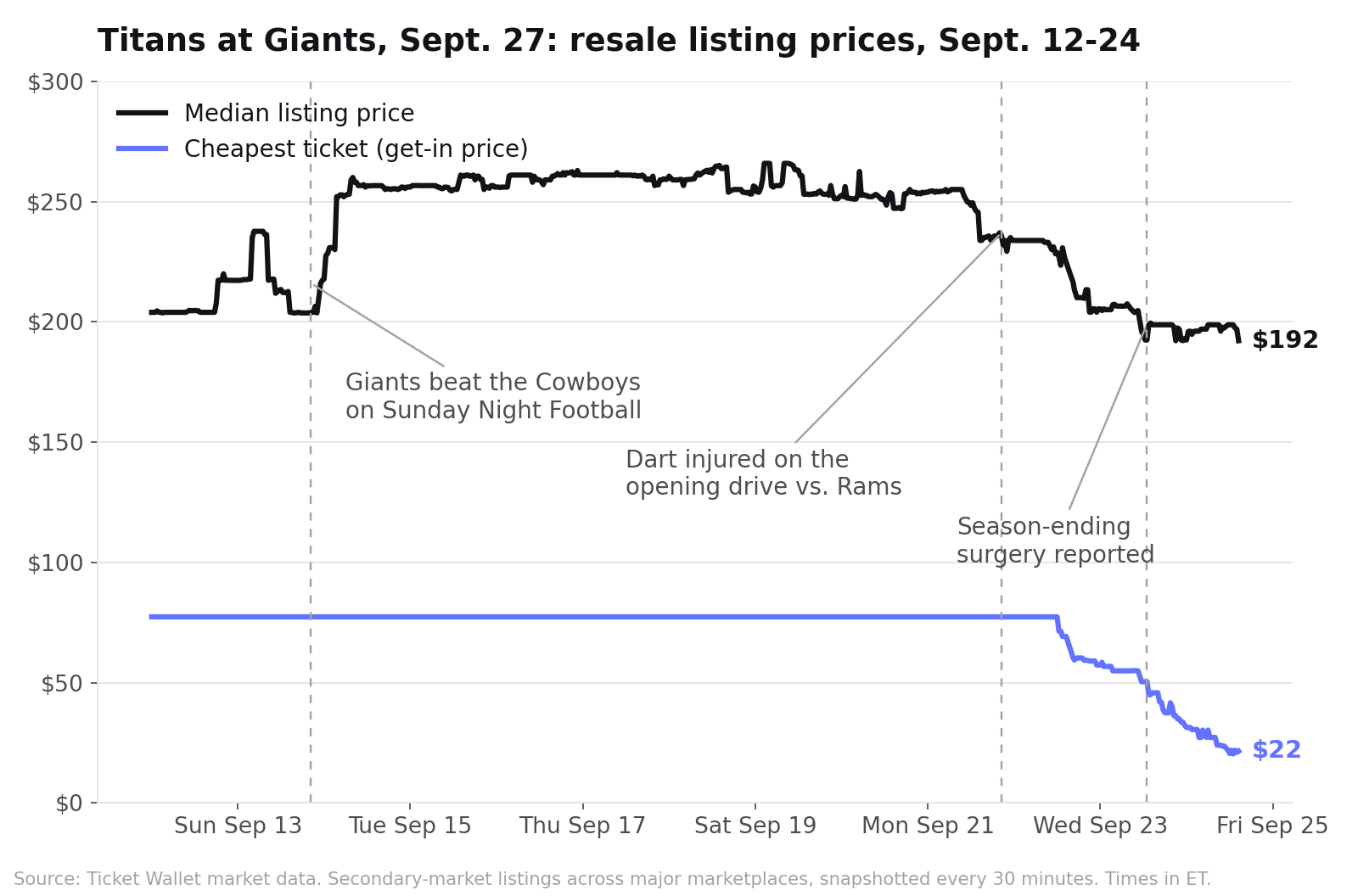
At 8 p.m. ET on Monday, minutes before kickoff, the cheapest ticket to the Titans game was $77 and the median listing was $237. By Thursday afternoon the get-in price was $21 and the median was $197. The average listing fell 38%, from $405 to $250. The cheapest tenth of the market, the seats casual fans actually buy, fell 48%. And the number of tickets for sale grew 45%, from about 6,300 to about 9,100, as season ticket holders decided they would rather sell than go. More supply and less demand, at the same time.
Every NFL game drifts lower during game week, but across the other 14 games on this weekend's slate the median fell 9% and the typical get-in price barely moved. The Giants game fell twice as far and lost almost three quarters of its floor.
It wasn't just one game
Across all seven remaining Giants home games, the median listing fell 11.6% from Monday to Thursday, the cheapest tenth of listings fell 19%, and the number of tickets for sale rose 8%. Over the same three days, the Jets' seven home games in the same building fell 2.1%. The other 200 NFL games left on the schedule fell 2.0%.
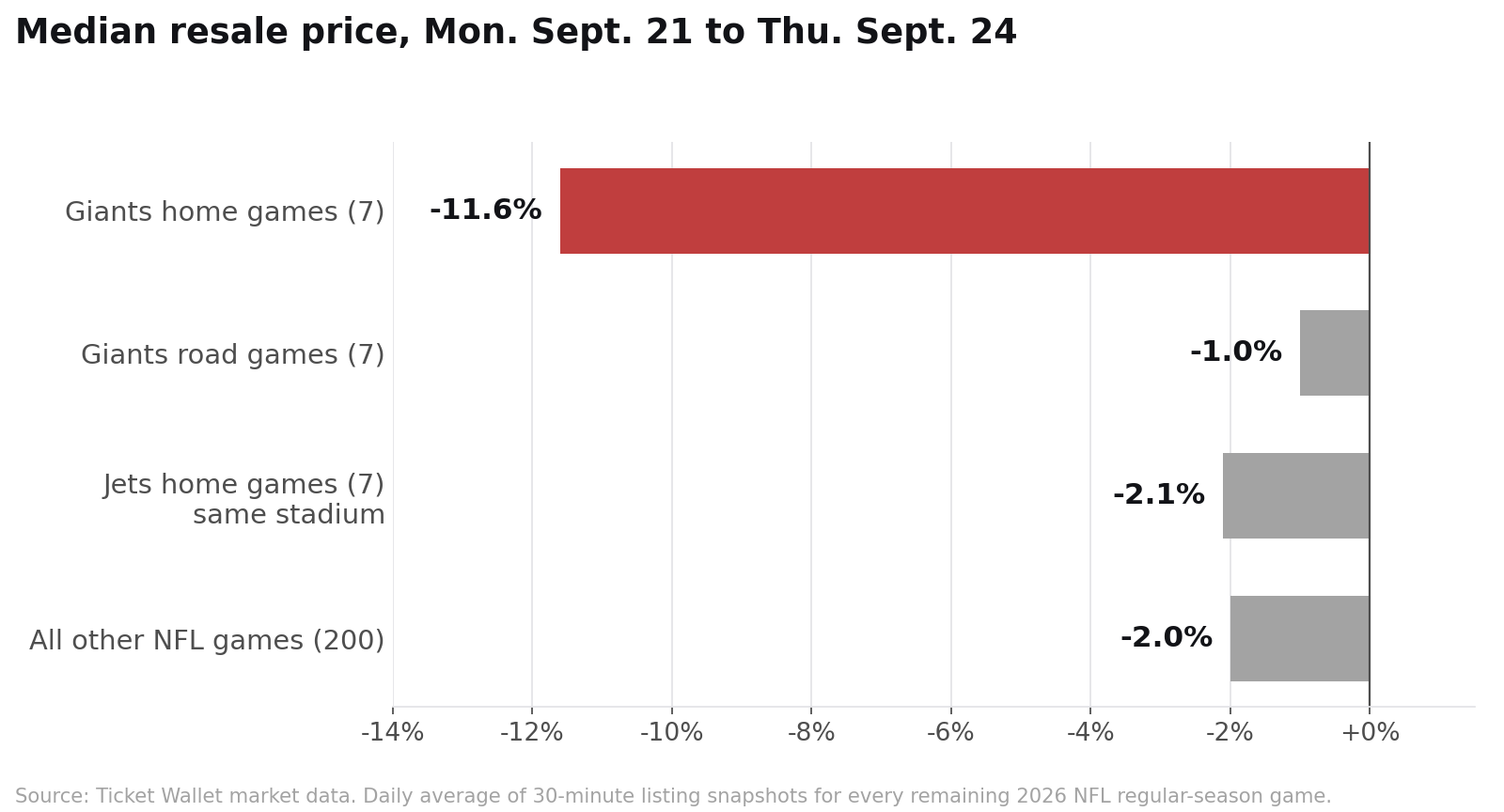
The market was thinking, not panicking. Giants road games barely moved, because road tickets are priced by the home crowd. And the one home game that didn't budge was the 49ers' visit on December 6, where the median sat at $352 on Monday and $352 on Thursday. That crowd is coming for the opponent.
It moves just as fast the other way. After the Giants beat Dallas on Sunday Night Football in Week 1, the median price of their home games was up 6.5% by Monday and the Titans game jumped 16%, from $216 to $251, while the rest of the league moved 0.2%. Ten days later, that same game was priced below where it started the season.
The star premium is real, and it's measurable
None of this is unique to the Giants. Economist Scott Kaplan matched NBA absence announcements against secondary-market listings and found that when a superstar is ruled out, prices for that game fall 4% to 22%, and the effect tracks popularity more than production. LeBron James missing a road game took 21% ($73 a ticket) off prices; Stephen Curry took 18% ($50).
Caitlin Clark, May 2025. When Clark strained her quad, TickPick's average purchase price for the Fever games she would miss fell from $137 to $80. The Fever-Sky game at the United Center, moved to a 20,000-seat NBA arena specifically for her, went from an $86 get-in price to $25.
Aaron Rodgers, September 2023. Four snaps into his Jets debut, Rodgers tore his Achilles. TicketIQ tracked the Jets-Chiefs game three weeks later falling 33% from its $599 average. Then reports surfaced that Taylor Swift would attend, and the get-in price rose 43% in 48 hours. Same seats, repriced twice on who would be in the building.
Jayson Tatum, in both directions. After his Achilles tear in the 2025 playoffs, the get-in price for the Celtics' next home game fell from about $600 to $162. When he returned this March, Gametime saw the get-in price jump 39% overnight, from $150 to $208, with sales nearly quadrupling in a day.
Lionel Messi, any time he sits. A hamstring kept him out of a March 2024 match at D.C. United, and StubHub's average price fell about 30% within a day. When Vancouver announced he wouldn't travel that May, the cheapest ticket fell more than 80% in under 24 hours.
Trades move markets too
Injuries take a star off the field. Trades move the star, and the demand follows him. When Luka Dončić was traded to the Lakers in February 2025, TickPick's average purchase price for Lakers home games rose 19%, from $253 to $303, while Mavericks home games fell 40%, from $187 to $112. The get-in price for his first game against Dallas doubled, from $96 to $195.
Tom Brady's move to Tampa Bay in 2020 sent Buccaneers resale prices up 135% year over year and Patriots prices down 39%, the steepest drop in the league, per TicketIQ. Shohei Ohtani's $700 million contract did the same for the Dodgers: the cheapest home-opener ticket went from $190 to $455 within a week, and the average price paid for 2024 home games jumped 57%.
What this means if you're holding tickets
Every one of these stories has the same shape: something happens on a Monday night, and by Tuesday morning the market has repriced. The seller who adjusted Giants tickets Monday night sold into a market with 6,300 listings. The seller who checked back Thursday was competing with 9,100 listings and a $21 floor, still priced 20% to 40% above where the market had gone.
This is why we don't tell sellers to set a price and forget it. Our AI pricing watches every comparable listing in the market, every 30 minutes, and reprices your seats against live demand across eight-plus marketplaces: up when your team beats Dallas on national television, down when your quarterback goes into the medical tent, before you've read the injury report. It doesn't panic, it doesn't hold out for a price that stopped existing on Tuesday, and it won't miss the bounce if Dart is back for a playoff push. Sellers on Ticket Wallet average a 27% revenue lift over pricing on their own, and weeks like this one are a big reason why.
Market data: Ticket Wallet 30-minute snapshots of secondary-market listings across major marketplaces for every 2026 NFL regular-season game, Sept. 12-24, 2026. Third-party figures via TickPick, TicketIQ, Gametime, StubHub and Economic Inquiry. Hero photo: U.S. Department of Defense, public domain.